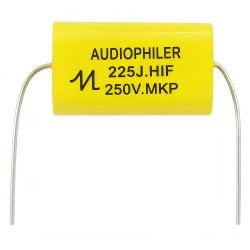
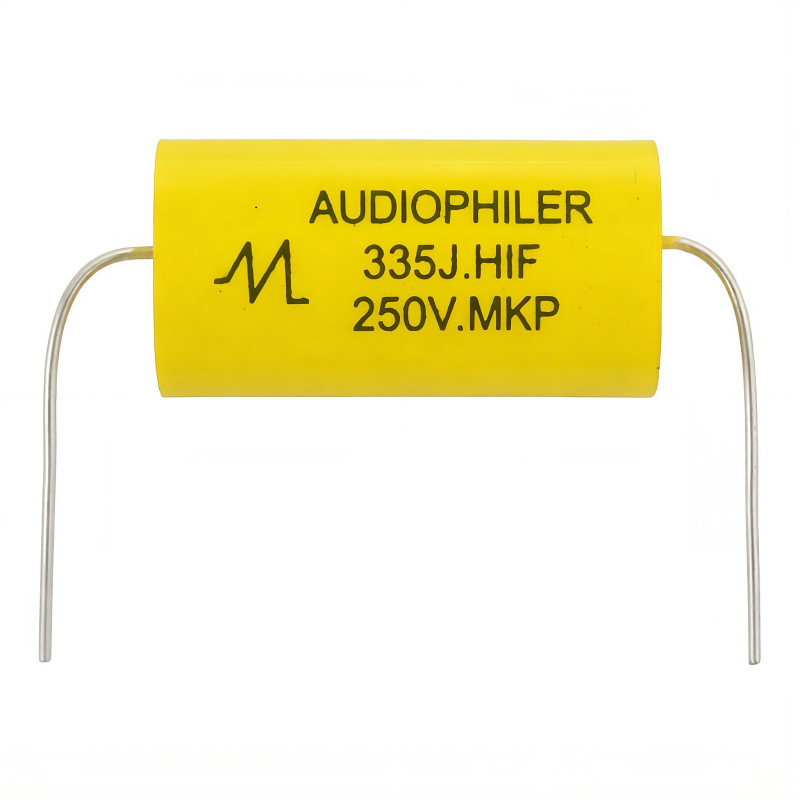


Audio film capacitor 3.3uF MKP. 335J.HIF.
Technical data :
MKP (metallised polypropylene) capacitors are electronic components used in various audio applications. They are mainly used for their good dielectric properties, low loss and stability over a wide frequency range. Here are some applications of MKP capacitors in the audio field:
Filtering: MKP capacitors are often used to build filters in audio circuits. They can be used in low-pass, high-pass and band-pass filters, helping to separate different frequency bands and eliminate unwanted harmonics.
Tonal correction: In audio equipment such as amplifiers or preamplifiers, MKP capacitors can be used in tonal correction circuits, allowing the frequency response of the sound to be adjusted.
Active and passive crossovers: MKP capacitors are important components in crossover circuits in multiband loudspeakers. They can be used in both active and passive crossovers to direct the right frequency bands to the right loudspeakers.
Attack time extension: In some audio systems, MKP capacitors can be used to control the attack time of a sound or signal. They can affect the characteristics of the sound, for example in compression circuits.
Distortion reduction: MKP capacitors can help reduce electromagnetic interference or surges in audio circuits, which can improve sound quality and minimise noise.
Capacitor buffers: In some cases, MKP capacitors can be used as capacitor buffers in audio circuits to help separate circuits and prevent one circuit from affecting another.
Interference radiation: In some audio circuits where electromagnetic interference is present, MKP capacitors can be used to radiate interference and minimise the effect of noise on the audio signal.
The product was placed on the market within the EU before December 13, 2024.
High Voltage and Current – This component can operate at high voltages and currents, posing a risk of electric shock. Pay attention to the maximum voltage and current values, as well as appropriate markings indicating these limits.
Caution During Installation – Ensure that the components are correctly mounted in the circuit, as improper connections can lead to overheating, damage, or fire.
Corrosion – Avoid contact with moisture: Fastening components should be protected from prolonged exposure to moisture or aggressive chemicals that can cause corrosion.
Use of protective coatings – Ensure that the components are protected with an anti-corrosion coating suitable for the operating environment (e.g., galvanizing, epoxy coatings). Regular maintenance: Inspect components for signs of corrosion and replace them as needed.
Mechanical damage – Do not exceed the maximum tightening torque: Over-tightening can damage the thread or weaken the fastening components. Use tools with the correct torque rating.
Avoid dynamic loads beyond specifications – Bolts and screws should be used according to their intended purpose, especially in applications exposed to vibrations or impacts.
Pre-use inspection – Before installation, check components for deformation, cracks, or other damage.
Improper use – Ensure you are using fastening components of the correct size, material, and strength class for the given application.
Do not use damaged components – Bolts, screws, and washers with visible mechanical damage or corrosion should be immediately replaced.
Avoid improper assembly – Ensure proper alignment and compression to avoid stresses in the fastening material.
Use of appropriate tools – Use tools that meet specifications for assembly and disassembly (e.g., torque wrenches).
Swallowing Hazard – Small fastening components, such as screws, nuts, or washers, can pose a choking or swallowing hazard, especially for children. They should be stored in a place out of reach of children.
Spreading of Small Components – These components can pose a tripping or loss hazard during work. They should be stored in containers that prevent spillage.
| Manufacturer (Private Label) (EU) 2023/988 (GPSR) | |
|---|---|
| Name: | Superelektronika sp. z o.o. |
| Address: | ul. gen. K. Sosnkowskiego 26/83 05-300 Mińsk Mazowiecki, Poland |
| E-mail: | sklep@superelektronika.pl |
| Responsible Person (EU) 2023/988 (GPSR) | |
| Full Name: | Radosław Jaromin |
| Address: | Arynów 46A 05-300 Mińsk Mazowiecki, Poland |
| E-mail: | radoslaw.jaromin@gmail.com |


You might also like